The Flemish Government has drawn up clear principles for the use of AI: democratic, trustworthy and human-centred AI, deployed by self-aware and competent staff, with careful data use and management, and with consideration for people and the planet. Whether AI is trustworthy depends, in turn, on eight conditions:
- societal and environmental well-being;
- transparency and explainability;
- accountability and contestability;
- human control and oversight;
- fairness, inclusion and non-discrimination;
- lawfulness and compliance;
- robustness and safety;
privacy and data protection.
The Flemish Government has drawn up clear principles for the use of AI: democratic, trustworthy and human-centred AI, deployed by self-aware and competent staff, with careful data use and management, and with consideration for people and the planet.
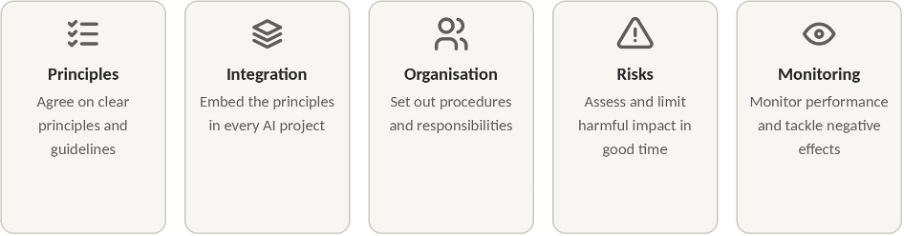
Good principles and conditions, but how do you translate them into a concrete governance structure? Which rules should staff follow? How do we keep track of whether these principles are being put into practice? And how do we put things right if they are not? Governance does not stop at proclaiming principles; it needs to be given concrete institutional form. That includes guidelines, procedures, responsibilities, awareness-raising, and monitoring mechanisms.