Get started with AI literacy in your organisation

Explore here
Paper collage. A photograph of the Atomium in Brussels, cut into diagonal strips and reassembled over a grid of numbers.
07.04.2026

Event report: ‘Digital autonomy: turning strategic independence into business opportunity’

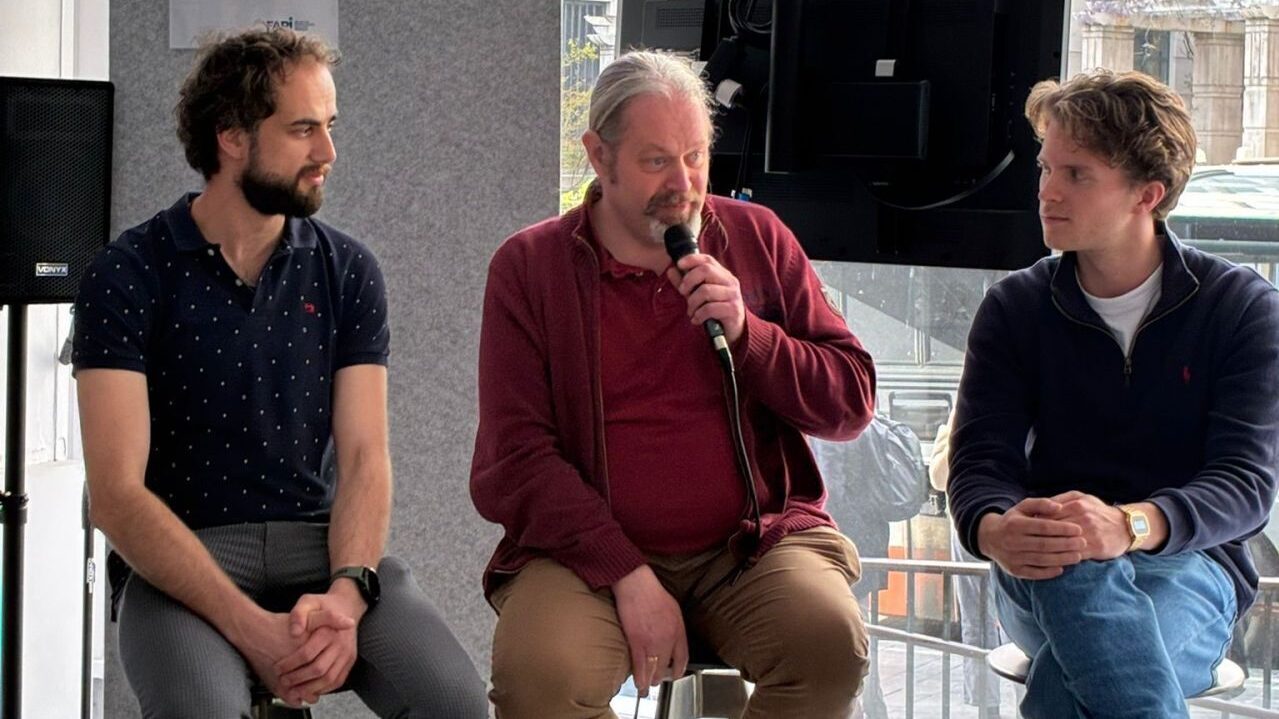
On Tuesday, 31 March 2026, sustAIn.Brussels organised a debate on digital sovereignty and the opportunities it presents for SMEs, in collaboration with the Knowledge Centre Data & Society. Three speakers  - Jurgen Gaeremyn (BeLibre), Daan Witte (soev.ai), and Christopher Peeters (Lecroq) - discussed what digital autonomy actually means and how to put it into practice.
Digital dependency as a starting point

The discussion opened with a concrete observation: the strong dependency of public and private organisations on large technology companies, particularly American players. Jurgen Gaeremyn illustrated this with his own research into the digital infrastructure of public services in Flanders, which showed that the majority rely on Microsoft services, creating what he described as a potential 'single point of failure'.

This finding barely triggered any political or media response in Belgium, whereas similar insights in the Netherlands were picked up widely. This contrast became a recurring theme throughout the conversation: Belgium appears to be lagging behind both in the debate and in practice around digital sovereignty. Can we still turn that lag to our advantage?

What is digital sovereignty (and what isn't it)?

A central question during the panel was what digital sovereignty actually means. The speakers agreed that it is not a simple or straightforward concept.

Daan Witte emphasised that digital sovereignty is not primarily about security, but about control and flexibility. What matters, in his view, is that organisations retain control over their own data and systems and are not dependent on a single vendor. A key indicator of this is how easily you can switch providers. If that switch is difficult or near-impossible, he argued, you are dealing with vendor lock-in and therefore a lack of sovereignty.

Both Daan and Christopher pointed out that many solutions today present themselves as "sovereign" without actually being so. Large players such as Microsoft, for example, position certain cloud offerings as European or sovereign, while in reality providing no guarantee that users are independent or can escape their ecosystem.


Speakers Christopher Peeters, Jurgen Gaeremyn en Daan Witte

Vendor lock-in and the illusion of choice

The issue of vendor lock-in came up repeatedly. An illustrative example is GitHub, now owned by Microsoft. GitLab, GitHub's main competitor, found itself reliant on infrastructure (Azure) that following the acquisition was now owned by its competitor. It ultimately took the organisation three weeks to migrate to a different cloud provider. That is relatively fast, but the example shows how quickly sovereignty can shift due to a vendor's decisions, and how important flexibility in this area can be.

The essence of digital sovereignty, according to the speakers, therefore, lies not in where data is physically stored, but in the degree to which systems are interoperable and organisations have genuine freedom of choice.


From awareness to action

The speakers advocated a pragmatic approach for organisations seeking to become more digitally sovereign:

  1. Inventory your systems and dependencies.
  2. Conduct a risk analysis: which dependencies are problematic?
  3. Prioritise actions.
  4. Implement step by step, ideally driven by internal champions on the topic.

This approach also aligns with existing frameworks, such as the obligations under the Cyber Resilience Act, which requires organisations to map their software supply chain.

Organisations can start small, for example by replacing a single specific tool (such as a video conferencing tool) and gradually regain control.

Ecosystem as the missing link

A structural problem in Belgium is the lack of a supporting ecosystem. There are few companies specialising in open source or European alternatives, making it difficult for organisations to switch effectively. During the discussion, it also became clear that technology companies and consultants in attendance were still exploring ways to add digital sovereignty services to their portfolios.

This creates a classic chicken-and-egg problem: there is little demand because there is little supply, and vice versa. The speakers stressed that building a network of specialised companies is crucial to breaking this deadlock.

Other countries show that things can be done differently. In the Netherlands and France, digital sovereignty has long been a policy priority, with open source solutions actively encouraged, for example through procurement criteria.

Geopolitical dimension

The discussion also took on a pronounced geopolitical dimension. Examples such as the impact of sanctions on international organisations (where access to digital services was restricted) and the city of Copenhagen's decision to move away from Microsoft illustrate that digital dependency carries real political and economic risks.

Belgium too has potential vulnerabilities, for instance, critical infrastructure running on foreign technology. In extreme cases, this could lead to strategic pressure or coercion.

Practical challenges and limitations

Despite the fact that there is a lot of low-hanging fruit in the area of digital sovereignty, the Q&A also made clear that the transition to sovereign solutions is not without challenges:

  • Ease of use and integration often lag behind big tech offerings.
  • European alternatives are not always equally performant or feature-complete.
  • The transition often requires temporary parallel systems (hybrid models).
  • Dependencies exist at multiple layers: data, infrastructure, software, and AI.

The speakers acknowledged these limitations, but stressed that digital sovereignty is not a binary choice. Hybrid models are possible and often necessary: sensitive applications can run on sovereign systems, for example, while less critical ones remain elsewhere.

AI: opportunity or risk?

Finally, the role of artificial intelligence was also addressed. AI can accelerate software development and make experimentation easier, but brings new challenges as well, particularly around maintenance and error detection.

AI systems make different kinds of mistakes than humans, and these are often harder to detect. Over time, this could create new dependencies rather than reducing them.

Conclusion: start now, don't wait

The central message of the event was clear: digital sovereignty is not an abstract ideal, but a concrete strategic necessity and an opportunity for SMEs.

Belgium is currently lagging behind, but that also creates opportunities. Organisations that today invest in open source and European solutions can position themselves ahead of future regulation and market demand.

The speakers' call to action was therefore:

  • Ask critical questions of your vendors and raise the topic.
  • Put the subject on the agenda within organisations and policy.
  • Start small, but start now. This holds both for organisations seeking greater digital autonomy and for companies that see digital sovereignty as a business opportunity.

Or as it was summed up in the closing conclusion: "Be the change you want to see in the world."

About

AI-attribution: This report was drafted and translated by the authors using ChatGPT and proofread by the authors prior to publication.

Copyrights cover image: Anna Riepe & FARI via betterimagesofai.org

Upcoming event: Advancing Digital Sovereignty Initiatives in Belgium

How can we strengthen digital sovereignty in Belgium? On Thursday, May 7, we are organising an event together with BeLibre to enter into a dialogue about this with experts, policymakers, and engaged citizens.