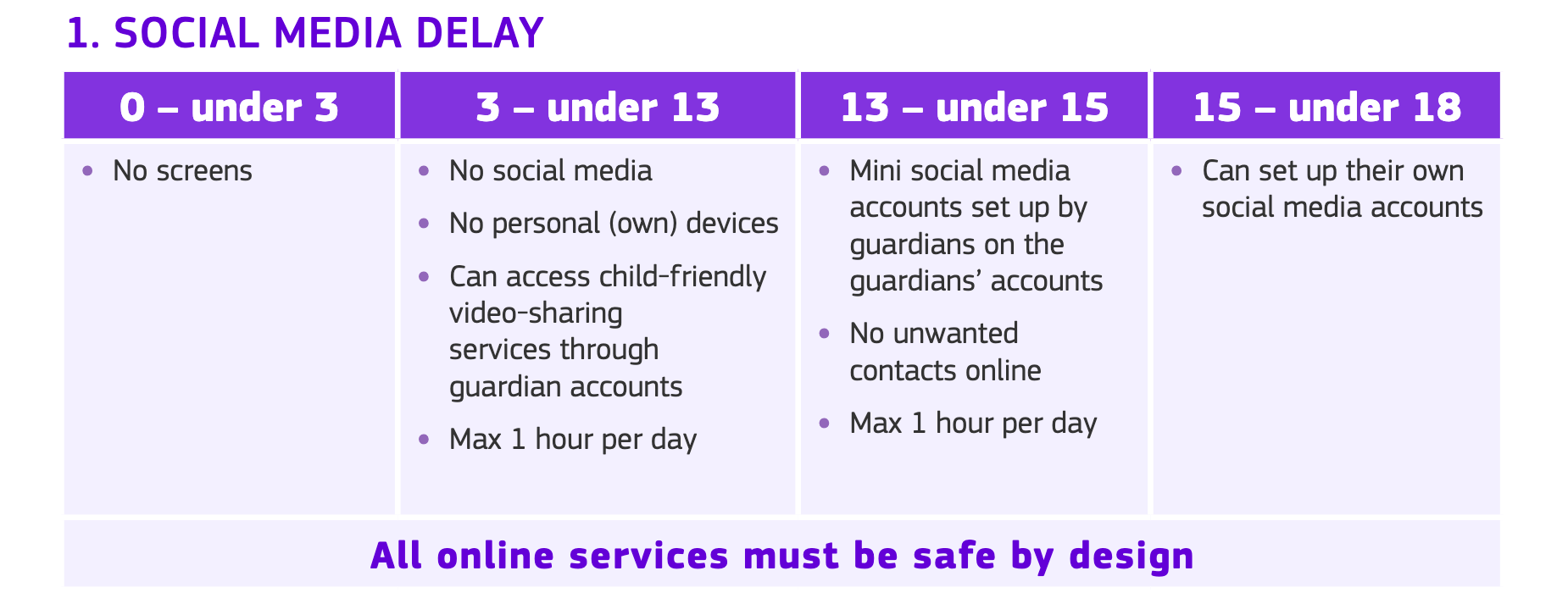
The design duties apply by default to all users, including unregistered ones, unless adulthood is established through age assurance (Art. 8(1)). Providers may skip that check only where they can establish with high confidence that the user is not a minor (Art. 32(3)). The main duties are:
- Addictive design (Art. 9): no autoplay without interruption moments, no notifications unrelated to the child's own activity, no rewards for live streaming, no engagement streaks, and time limits that protect school time and sleep.
- Recommender systems (Art. 10): explicit preferences take priority, engagement-based signals are off by default, no data from outside the service is used, and at least one non-profiled option is offered.
- Safe settings and contact safeguards (Arts. 11–12): geolocation, camera and microphone, contact recommendations and push notifications are off by default; no unsolicited contact; no live-streaming by default.
- Economic transactions (Art. 13): prices in virtual currency are shown in real currency, and minors are not exposed to variable reward systems such as loot boxes.
- AI companions and chatbots (Art. 14): no features likely to create emotional dependence, memory of past interactions off by default, testing before market placement and post-market monitoring (micro and small providers are exempt from the latter). Access below 13 only through guardian tools.
- App stores (Art. 16): an age-rating system, blocking of age-inappropriate apps, and support for the EU age-verification solution.
- Games (Art. 15) and agency of minors (Arts. 18–20): reduced design duties for games, child-friendly reporting and guardian tools.
The Commission may update these lists by delegated act (Art. 25).
Age assurance
Self-declaration is excluded, and Article 28(3) states that any age assurance measure "shall be zero knowledge proof". For the access delay, providers must rely exclusively on an EU age-verification solution based on an EU proof-of-age attestation (Art. 29(2)). European Digital Identity Wallets that meet the scheme are deemed compliant. Operating systems must share an age signal with in-scope providers, with the user's consent (Art. 29(6)). Until a delegated act is adopted, a guardian's self-declaration suffices for proof of parental responsibility (Art. 26(1)(c)).
Enforcement and timeline
Enforcement relies on existing DSA and AI Act structure (see Table 2). For very large platforms, the Commission proposes to communicate preliminary findings within [30] working days and to adopt a final decision within 90 working days (Art. 35). This contrasts with the nearly
nearly two years taken in recent TikTok proceedings. Very large platforms must also notify a compliance plan and have it independently audited at their own expense (Art. 5). The Commission finances its supervision through a fee of up to 0.03% of worldwide net income (Art. 36). For AI companions and chatbots, fines can reach 6% of worldwide turnover (Art. 34(2)). The Regulation would apply six months after entry into force, and a review is due by 31 August 2030 (Arts. 42–43). Parliament and Council can still amend the text, and several provisions still need to be confirmed.